
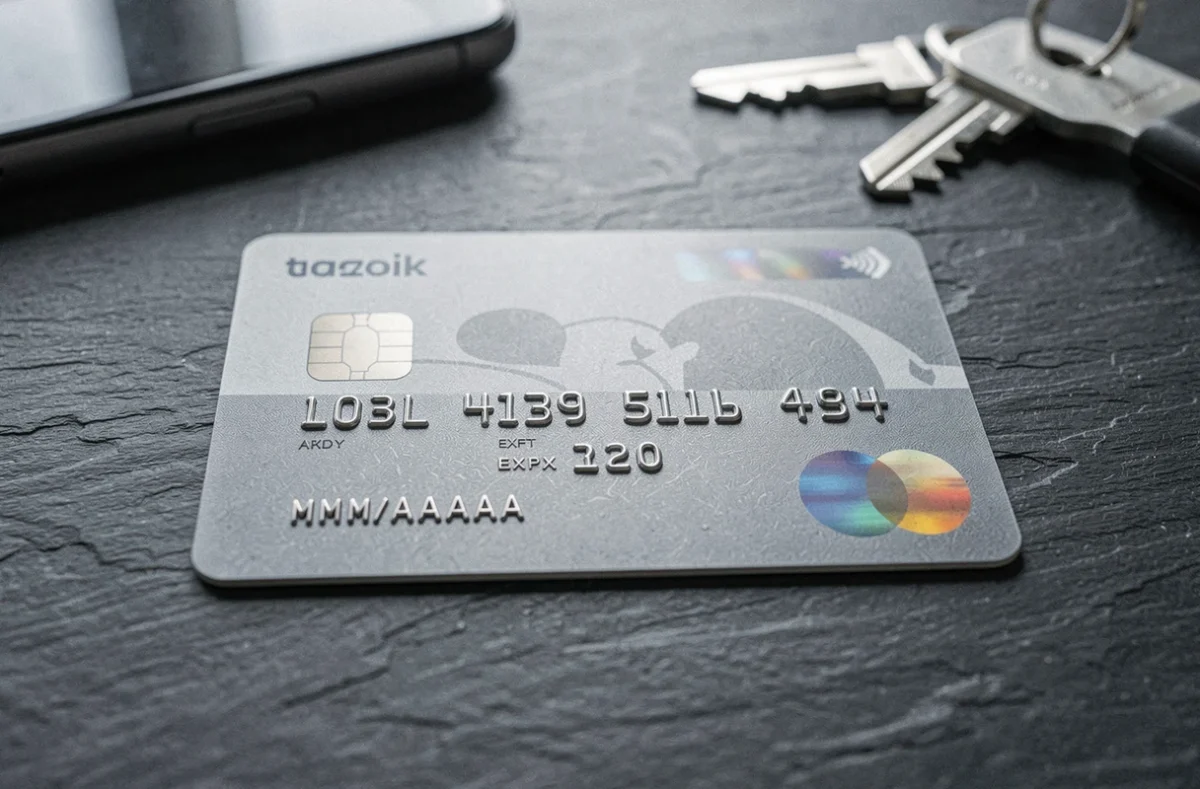
On every bank card, MM/YY indicates the month and year the payment card expires. MM is the month in two digits (01 to 12), and YY is the year in two digits. The MM/YYYY format displays the year in four digits. This date, embossed or printed on the front of the card, determines the last month in which the card can be used to pay for a purchase.
SEPA direct debits and card payments: two systems affected differently by the expiry date
The most common confusion concerns the link between the date printed on the card and recurring payments. A SEPA direct debit uses the account’s IBAN, not the card details. Renewing or expiring the card therefore has no effect on it.
A subscription charged directly to a saved card (streaming platform, online software, gym) works differently. If the card details are not updated after renewal, the payment may fail at the next billing cycle.
To better understand what MM/YY means and how MM/YYYY expiry works, distinguishing between these two systems is the first thing to learn before wondering whether a subscription will continue after a card change.
Two automated services can send updated card details to participating merchants: Visa Account Updater and Mastercard Automatic Billing Updater. How they work depends on both the issuing bank and the merchant taking part. In practice, some subscriptions continue without any action from the cardholder, while others do not. There is no universal guarantee.

MM/YY and MM/YYYY formats: reading and entering the date when paying online
Online payment forms ask for the expiry date in one of these two formats. MM/YY has four digits (for example, 09/27), while MM/YYYY has six (09/2027). Both indicate the same expiry date.
The card remains usable through the last day of the month shown. A date of 03/26 means the card expires on March 31, 2026, not March 1. This clarification helps avoid thinking a card has expired when it is still valid for the entire month.
Common entry errors
- Reversing the month and year: entering 27/09 instead of 09/27. The system detects a month greater than 12 and declines the transaction.
- Confusing the two- and four-digit year formats: entering 2027 in a field that expects 27, or vice versa. The transaction is declined immediately.
- Using the previous card’s expiry date after renewal. The card number and expiry date change together, so the old details no longer work.
A payment declined because of the expiry date does not indicate an issue with the account balance or spending limit. It means either that the details were entered incorrectly or that the card has expired.
Card renewal and saved subscriptions: what changes in different scenarios
Renewal at expiry (when the bank sends a new card before the old one expires) and replacement after loss or theft do not have the same effect on saved payments.
With a standard renewal, automatic update services (Visa Account Updater, Mastercard Automatic Billing Updater) may send the new details to participating merchants. The cardholder may not need to do anything.
After reporting a card lost or stolen, coverage by these services varies and should not be taken for granted. The bank issues a new card number, and the update conditions change. The most reliable approach is to check directly with the bank and update the most important recurring payments yourself (insurance, cloud hosting, phone subscription).
Card expiry and subscription cancellation: two different things
Letting a card expire does not automatically cancel a subscription. If the merchant receives updated details through the update services, it will continue charging the new card. To stop a card payment, you must cancel directly with the merchant, in accordance with the terms of the contract. Relying on the card’s expiry alone to stop a payment may lead to reminders, fees, or even referral to a debt collection agency.
Expiry dates and the security of bank card transactions
The expiry date is one of the details required to authorize a remote payment, along with the card number and security code (CVV). It plays a role in the verification process, but it is not a security measure on its own.
Its primary purpose is to require periodic renewal of the physical card and its associated details. This cycle limits how long compromised data can potentially be used. If a card number and CVV are stolen, they become unusable after the expiry date.
The expiry date does not replace the PIN or strong authentication (3D Secure). It is one of several checks. For online purchases, two-factor authentication remains the main barrier against fraud.
- The card number identifies the account and network (Visa, Mastercard).
- The CVV verifies that the card is physically present when the details are entered.
- The expiry date confirms that the card is still valid.
- Strong authentication (SMS, banking app) verifies the cardholder’s identity.
These four elements work in successive layers. None is sufficient on its own.
The expiry date in MM/YY or MM/YYYY format is one of the most visible details on a card, yet one of the least understood. It determines whether the card is valid, affects subscription continuity, and contributes to the security of remote payments. The most useful thing to do after receiving a new card is to update saved payment details before the first transaction is declined.