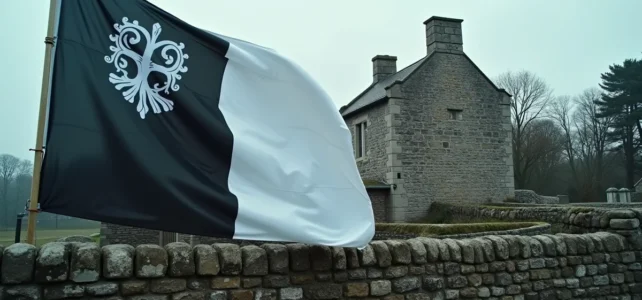
The Gwenn-ha-Du, literally “white and black” in Breton, is the flag of Brittany. Composed of nine horizontal stripes alternating black and white and a top left canton sprinkled with ermine spots, this flag has not withstood the test of time as one might assume. Its creation dates back to the 1920s, but the symbols it bears have roots much deeper in the region’s history.
Kroaz du and ermine: two distinct heraldic heritages
Before the Gwenn-ha-Du, Brittany did not have a unified flag. Two symbols coexisted without ever appearing on the same medium.
Recommended read : The revival of sending cards: a timeless art of communication
The first is the Kroaz du, the black cross on a white background. Used since the Middle Ages, this cross identified Breton fighters during the Crusades and conflicts with their neighbors. It served as a military rallying sign, akin to the French white cross or the English red cross.
The second symbol is the ermine, a small stylized motif that appears on the coat of arms of the Dukes of Brittany from the 13th century. The ermine is not just an ornament: it represents the fur of the animal of the same name, whose white coat speckled with black was used to line ducal cloaks. In heraldry, ermine spots traditionally symbolize purity and nobility.
See also : The audiovisual school, a human and creative adventure
To delve deeper into the origin of the Breton flag, its stripes and ermines deserve to be read in light of these two distinct heraldic traditions, which were merged late in the 20th century.

The Gwenn-ha-Du: a flag designed in the 1920s
The Breton flag as we know it today is a modern creation. Morvan Marchal, an architect and activist of the Breton movement, designed it in the 1920s. The goal was to provide Brittany with a unique regional emblem, readable and distinct from fragmented historical banners.
The logic behind the nine stripes
The nine horizontal stripes are not decorative. Each stripe represents a historical diocese of Brittany. The four white stripes correspond to the Breton-speaking dioceses (Léon, Trégor, Cornouaille, Vannes). The five black stripes represent the Gallo-speaking dioceses (Dol, Nantes, Rennes, Saint-Malo, Saint-Brieuc).
This division into two linguistic groups was a deliberate political choice. The flag asserted the unity of historical Brittany across five departments, including Loire-Atlantique, and recognized the Breton linguistic duality.
The ermine spots in the canton
The white canton in the top left features black ermine spots. Their number has varied according to versions: the most widely circulated version has eleven. These ermines connect the modern flag to the medieval ducal heritage, ensuring a symbolic continuity with the former Duchy of Brittany.
Forbidden symbol then rehabilitated: the political journey of the Gwenn-ha-Du
The Gwenn-ha-Du has not always been favored by the French authorities. Its political history is marked by periods of distrust and appropriation.
At its creation, the flag circulated mainly among Breton autonomist and cultural circles. During World War II, some Breton collaborationist movements used it, which permanently tarnished its image. After the Liberation, displaying the Gwenn-ha-Du became suspect, associated with separatism.
Rehabilitation gradually occurred from the 1960s-1970s with the Breton cultural revival. Fest-noz, associations defending the Breton language, and ecological movements adopted it. The flag transitioned from a controversial political symbol to a unifying cultural emblem.
Since the 2010s, several Breton municipalities like Rennes and Brest display the Gwenn-ha-Du on public buildings alongside the French flag. This institutionalization marks a step in the official recognition of the regional symbol within the Republic.
Contemporary variants and graphic derivatives of the Breton flag
The historical Gwenn-ha-Du is no longer the only Breton emblem in circulation. Several graphic variants have emerged in recent years, driven by tourism, commercial, and activist uses.
- The Blue Hermine of Brittany, combining stylized ermine and waves, has become prominent on tourist and textile materials since the 2010s as a co-logo for Breton companies and cultural associations.
- Maritime versions of the flag, incorporating wave patterns or gradients of blue, can be found on event signage and merchandise.
- The Gwenn-ha-Du regularly appears in ecological, agricultural, and social demonstrations, where it serves as a marker of territorial identity rather than a separatist claim.
This proliferation of derivatives shows that the symbol has largely transcended its original framework. The Gwenn-ha-Du has become an adaptable graphic support, varied according to the communication needs of each Breton actor.
Breton ermine and popular culture: a motif that transcends vexillology
The ermine is not limited to the flag. This motif can be found on municipal coats of arms, sports team jerseys, shop signs, and tattoos. In Rennes, the city’s coat of arms features ermines, a direct legacy from the ducal era.
The triskell, another Celtic symbol frequently associated with Brittany, does not appear on the Gwenn-ha-Du. The two motifs coexist in the Breton imagination without merging: the ermine refers to political and feudal history, while the triskell relates to the Celtic and spiritual dimension.
This distinction matters because it reflects the different layers of Breton identity. The Breton flag carries the memory of the dioceses and the duchy, not that of the mythologized Celtic Brittany. It is an administrative and political emblem before being an esoteric symbol, even if regional pride ultimately blurs the lines.