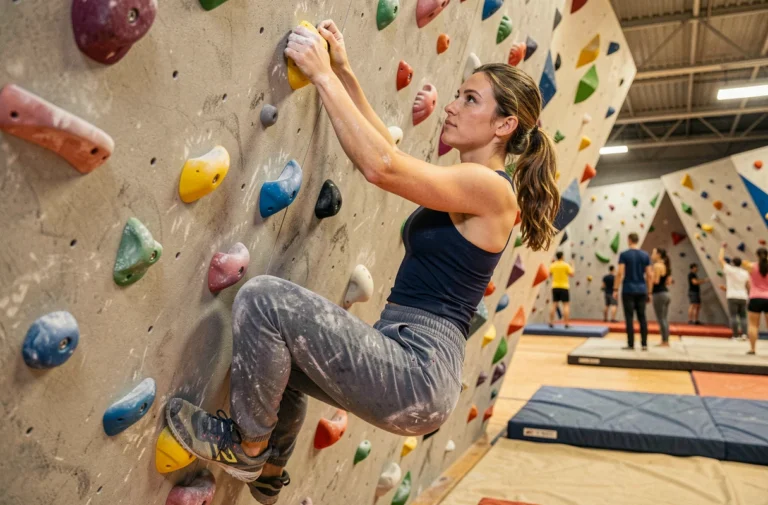
A photo of a public figure shared on a social network does not have the same legal status or reliability as a snapshot taken without their knowledge. In the case of Alicia Dauby, a sports journalist visible on La chaîne L’Équipe, the distinction between official photos and stolen shots relies on technical, contextual, and editorial clues that most internet users do not verify before sharing an image.
Visual verification of Alicia Dauby’s photos: three concrete criteria
Before questioning the source of a snapshot, the visual content itself provides usable clues. An official photo generally follows a logic of controlled staging: careful framing, even lighting, background consistent with the claimed context (TV set, press event, professional shoot).
A stolen shot often presents the opposite characteristics: skewed angle, motion blur, abrupt cropping that cuts off part of the subject. The photographed person does not look at the camera, or their expression conveys surprise.
When it comes to distinguishing official or stolen photos of Alicia Dauby, a third criterion is added: the presence or absence of the spouse. The posts she controls on Instagram showcase her professional life, her pregnancy, selected family moments. Her husband is consistently out of frame or in the background, which serves as a strong marker of content validated by the journalist herself.
Distribution channel and editorial context: where the photo appears changes everything
The platform on which an image circulates first is the most reliable clue. A photo published directly on Alicia Dauby’s Instagram account (identifiable by her verified handle) has a very different status from an image picked up on an anonymous blog or a celebrity content aggregator.
Posts controlled by the journalist
The visual content that Alicia Dauby shares follows a professional and family narrative arc: L’Équipe de Greg set, field reports, stages of pregnancy, birth. The couple as such is not a subject she publicly stages.
This editorial constant allows for quick identification of an anomaly. If a supposedly official image shows the couple in an intimate context (restaurant, vacation, home), without Alicia Dauby having shared it on her own channels, the likelihood that it is an unauthorized shot increases significantly.
Reposted by third-party sites
Several niche wedding or celebrity sites republishing photos of Alicia Dauby do not cite any specific source. The absence of photographic credit, “courtesy of” mention, or link to an original publication signals content for which the distribution authorization is not established.
A useful reflex: trace back to the first occurrence of an image using a reverse search tool. If the initial source is neither the journalist’s account nor a media outlet with a distribution agreement, the shot falls into the category of unvalidated images.
Right to image in France: what the law says about stolen photos of personalities
The French legal framework protects the right to image of any person, including public figures, as long as the photo falls within the private sphere. A shot taken in a private place without consent constitutes a punishable infringement, regardless of the subject’s notoriety.
The nuance lies in the context: a journalist filmed on a television set performs a public function, and screenshots of these appearances are lawful. A photo taken during a personal outing, in the street or in a store, falls under a different regime.
- Photo on a TV set or during a press event: generally lawful dissemination, the person performs a public information mission
- Photo in a public place but outside of function (shopping, walking): the right to image applies, dissemination requires consent
- Photo in a private place (home, personal party): maximum protection, any dissemination without agreement exposes to legal action
In the case of Alicia Dauby, the fact that no official wedding photo has been publicly shared reinforces this framework. Any image claiming to show the ceremony or intimate marital moments is suspect by default, since the journalist has never contributed to this visual register.

Technical clues in the image file: metadata and compression
Beyond the visible content, the photo file itself contains exploitable traces. The EXIF data embedded in a JPEG records the camera model, date of capture, and sometimes the GPS coordinates of the capture location.
On an official photo shared via Instagram or a press service, this metadata is automatically cleaned by the platform during upload. An image retaining detailed EXIF data (consumer camera model, precise geolocation) suggests that it has not passed through a professional editorial channel.
The compression rate offers another clue. An image recompressed multiple times (copied from site to site) exhibits characteristic visual artifacts: halos around contours, degradation of dark areas, pixelation of fine details. This type of degradation is common in stolen shots that circulate from blog to blog without a good resolution original source.
- Absent or minimal EXIF metadata: consistent with a publication via social network or photo agency
- Complete EXIF metadata with GPS: the file has likely not passed through an official channel
- Multiple compression artifacts: the image has been copied and recompressed, a sign of uncontrolled circulation
- High and even resolution: compatible with a professional source file
The combination of these checks—visual, contextual, legal, and technical—allows for positioning a photo of Alicia Dauby on a spectrum ranging from fully authorized content to a stolen shot. The complete absence of couple photos validated by the journalist remains the simplest filter: if an image shows what she has never chosen to show, caution is warranted before any sharing.