Dinner turns into an arm-wrestling match over the broccoli, the living room looks like a Lego battlefield, and no one can find the communication notebook. These daily micro-tensions do not indicate a dysfunction: they are part of the normal functioning of family life. The difference between a household that is exhausted and one that holds together often lies in a few concrete adjustments, repeated week after week.
Parental technoférence: when adults’ phones disrupt family life
Have you ever noticed that a child raises their voice just when you check your phone? This phenomenon has a name: technoférence. It refers to the interruptions in parent-child interaction caused by the adults’ devices themselves.
Public Health France identifies these micro-disruptions as an emerging issue in early relationships. The problem does not solely stem from children’s screen time. Parental phone use fragments the attention given to the child, even when the child is not touching any device.
Specifically, a parent scrolling during snack time sends an unintentional signal: what is happening on the screen is more interesting than what is happening at the table. The child compensates by seeking attention in other ways, often through behaviors that are later labeled as “difficult.”
Many families find useful resources by browsing the family page on Butterfly Mag, particularly on daily organization and parent-child relationships.
A simple rule works better than an educational speech: physically place the phone in another room during transition times (after school, mealtime, bedtime). No heroic willpower is needed. A closed drawer is enough to restore attention quality.

Children’s screens: focus on weekends rather than imposing a rigid daily limit
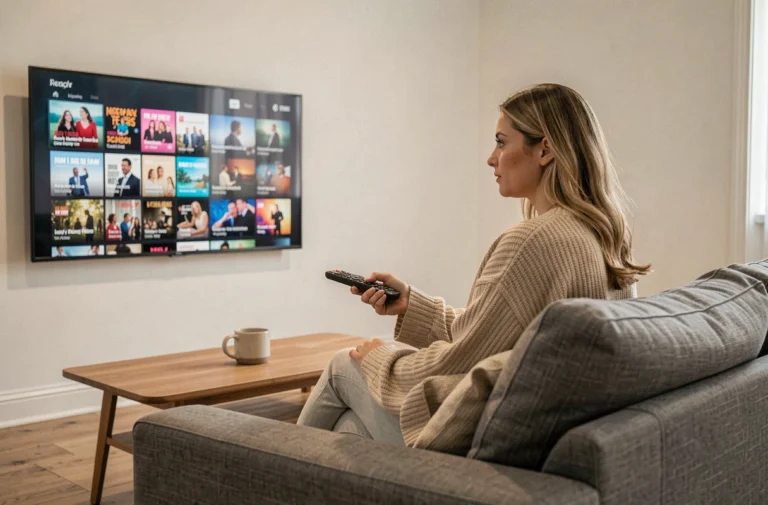
Screen management remains the topic that crystallizes the most tension in households. Most advice suggests a single daily limit (one hour, two hours). This approach ignores a documented fact.
The Enabée study by Public Health France, published in September 2025, shows that screen time is about twice as high on non-school days. Children aged 3-5 spend an average of 1 hour and 22 minutes per day in front of a screen, those aged 6-8 about 1 hour and 53 minutes, and those aged 9-11 reach 2 hours and 33 minutes.
Rather than a uniform rule, it is better to concentrate efforts on the time slots where the drift is strongest: Saturday mornings, Sunday afternoons, school holidays. A clear framework for those moments (planned alternative activity, negotiated start and end times) has more effect than a blanket ban that no one respects.
Remove screens from the bedroom at night
The Enabée study also highlights the presence of screens in the bedroom as a distinct factor from mere usage time. Children aged 9-11 are the most affected.
An device out of the bedroom after bedtime changes the game regarding sleep without requiring daily negotiation over usage minutes. It is a housing arrangement rule, not a punishment. A family charging station in the hallway or kitchen resolves the issue for everyone, including adults.
Division of household tasks: going beyond good intentions
The mental load cannot be resolved by asking “how can I help you?”. This phrase, well-intentioned as it may be, maintains the idea that one person is in charge and the other executes upon request.
A functioning division relies on three concrete elements:
- Identify invisible tasks (making medical appointments, tracking clothes that have become too small, managing food stock) and list them explicitly. What is not named cannot be distributed.
- Assign complete areas rather than isolated actions. The person managing meals also handles the shopping list and fridge organization, from start to finish.
- Review the division every two to three months, as work constraints and children’s needs change.
Handing over an entire area is better than ten occasional helping hands. The person responsible for an area makes decisions without validation, which eliminates back-and-forth and decision fatigue for the other parent.

Short family rituals: focus on regularity rather than events
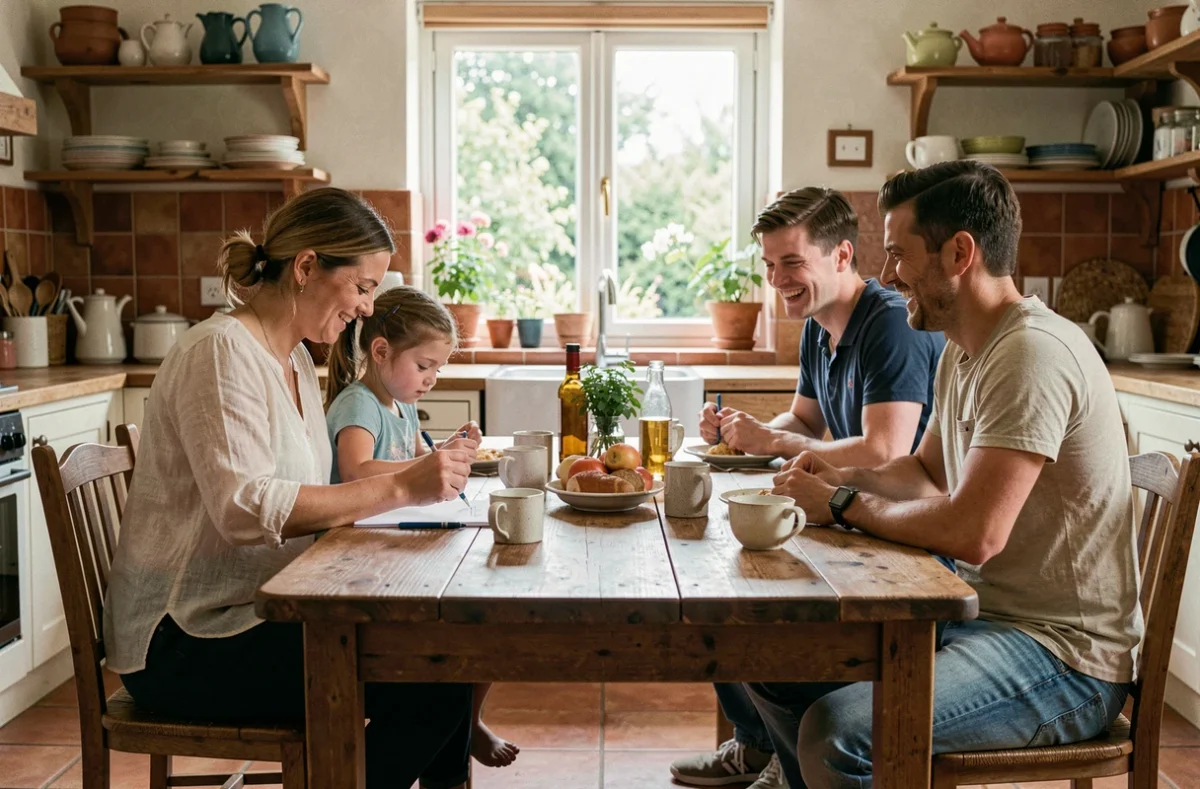
The strongest childhood memories do not come from exceptional vacations. They come from small repeated habits: the Wednesday card game, the Sunday morning walk, the moment when everyone shares something good and something hard from their day during dinner.
An effective family ritual meets three conditions:
- It lasts less than thirty minutes (beyond that, logistics become a barrier and the ritual disappears within weeks).
- It occurs at a fixed frequency, regardless of mood or schedule.
- It requires no special materials or preparation.
Regularity creates a sense of security, not duration. A child who knows that every Friday evening the family plays together for twenty minutes integrates a stable reference into their week.
Adapt the ritual to age without eliminating it
As children grow, the temptation is to abandon rituals that have become “babyish.” It is better to evolve them. The bedtime story becomes a discussion about a movie. The walk becomes a bike ride. The framework remains, the content changes.
A harmonious family life does not rely on the absence of friction, but on clear habits that reduce areas of ambiguity. Phones set down during key moments, screens framed where drift is real, household tasks assigned by area, short rituals maintained over time. Four concrete levers that require little time but a lot of consistency.